
First Footers
Crossing thresholds and starting afresh.

It’s New Year’s Day, 1937.
6 members of the Creagh Dhu Mountaineering Club set off from Aviemore at 1.30 am in heavy snow storms and make the long trek along the Lairig Ghru, the notorious mountain pass through the Cairngorms. With four bottles of whisky to accompany them, they endure the blizzard, the wind and the granite of the mountains in the hope of being ‘first-footers’ in the famous bothy below the Devil’s Point, Corrour. (A bothy, in case it’s an unfamiliar term, is a free mountain shelter that can be used by any passerby).1
Trudging through the whiteness, they arrive after 6 pm but their dreams of winning the race to the bothy are soon dashed as they realise that A. Lavery and D. McGovern are already there. The pair took no chances and made sure to get to Corrour by 12.15 am.
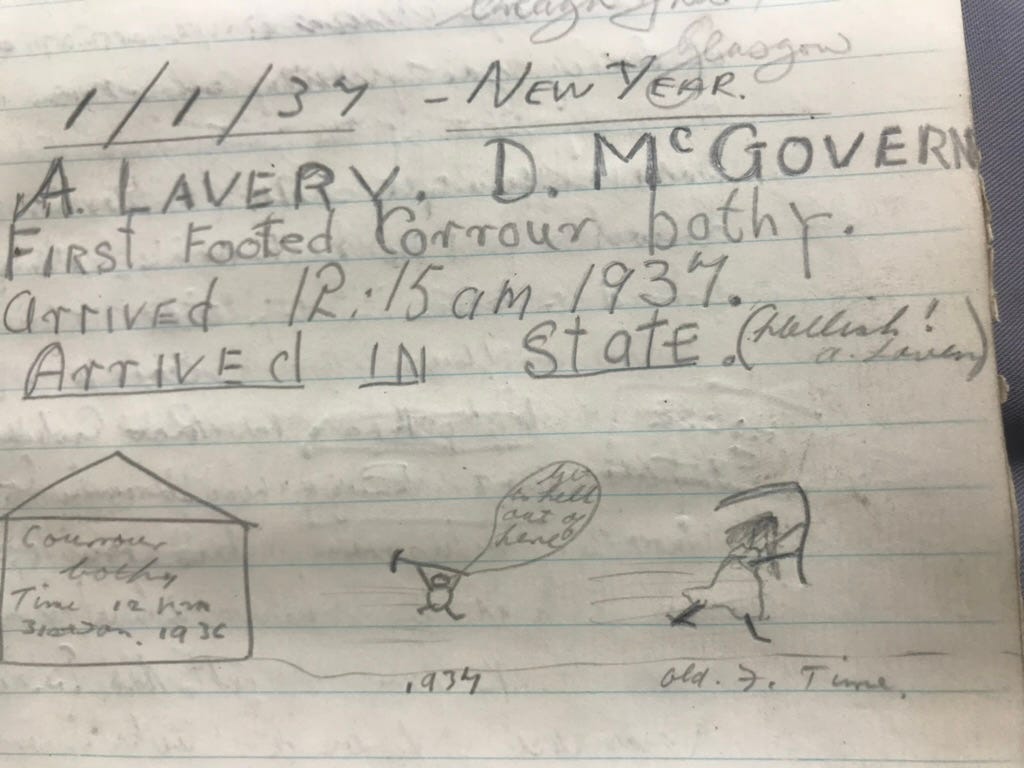
First-footing is an old Scottish tradition. It’s the practice of being the first person to cross the threshold of a house as the new year begins. So folk legend goes, all the better if it’s a young man with dark hair as this will bring you luck. Make sure you bring a gift, too, if you are a first-footer, perhaps a coal to signify warmth for the coming months.
It’s a way of marking the new year, a time to start afresh, and the climb out of darkness into the light of spring. Light that brings life and hope. The in-between space of the threshold, the doorway separating outside from in, a boundary between one state and another, has often held ritual significance for communities around the world. Brides used to be and may still be carried over the doorway of a new house. In Christian tradition, baptismal fonts were just inside the church door and baptism was described as a liminal rite. In Viking Sagas the living commune with the dead through mortuary doors. Thresholds and boundaries mark a transition in space but also time.
Even our word January comes, of course, from the name of the Roman God for doors, time, transitions. Janus, the two-faced deity, is the master of endings but also beginnings.
A. Lavery may not have been meditating on Roman myth, but he was clearly aware of the passing of time and the significance of ushering in the new year. His accompanying sketch in the bothy visitors’ book shows 1937 chasing away Old Father Time.
Today marks my own celebration of the new year and new starts.
It’s not the winter solstice, nor January 1, but the day on which the mornings for the first time begin to lengthen once more. We have had the latest sunrise and now the daybreak will come earlier and earlier, by several minutes every morning, cantering towards the almost endless glow of summer. Living in the Scottish Highlands, where nights are long and dark, I welcome this day.
It’s a special year, too, this one. For the first time in forever, I am not starting the new year as an academic, having left the profession that I beavered away at for almost 20 years. I am still writing, researching, applying for grants, fellowships. Just not in the career I thought I would do all my life, but which ended up wearing me down. Now, strangely, I feel more inspired by creative energy than ever before. And this year marks the publication of my first trade non-fiction book, Bothy: In Search of Simple Shelter. (Available soon in all good bookshops of course courtesy of William Collins).
If you like the tale of the first-footers, there are plenty more like it in my book.
The visitor books from bothies, some dating back to the 1920s, are full of tales like those of the first-footers, and they are a large part of what sparked my interest in bothies. (Not to mention the amazing locations where bothies are, of course, amidst mountains or nestled next to the coast). As a historian, I couldn’t help but be drawn to the archives of ordinary people in particular places. People write down songs, relate their tales of adventures, draw, scribble, and joke. Leafing through volumes in archives or in bothies, characters jumped off the page and their stories came alive. These people, the buildings, the landscapes are at the heart of the book I decided I had to write when I first visited a bothy. I wanted to explore how we see these landscapes, and what we owe to them and to each other.
Bothy and its making matter to me. It’s a new start, a departure from the world I have known. Not only have I given up academia, but, leaving stable accommodation, I am now living on the west coast of Scotland. It looks idyllic, and in many ways it is, but jumping between short-term housing, it’s a bumpy ride too. Whoever said fresh beginnings were easy, though.
But I wouldn’t change it. Endings a plenty, but also beginnings. This book has allowed me to weave together strands that matter to me - histories, communities, environments, living worlds, tales of past, present and future told at a time of personal transformation as well as environmental crisis.
This newsletter is a place to share my weekly musings on pasts, people and places.
I will tell of the different places I have visited for the many research projects I have worked on - archives and communities around the world, all those fascinating wormholes that I have gone down, the paths followed, objects seen, and documents read. A bit of history, a bit of nature and environment, a bit of travel.
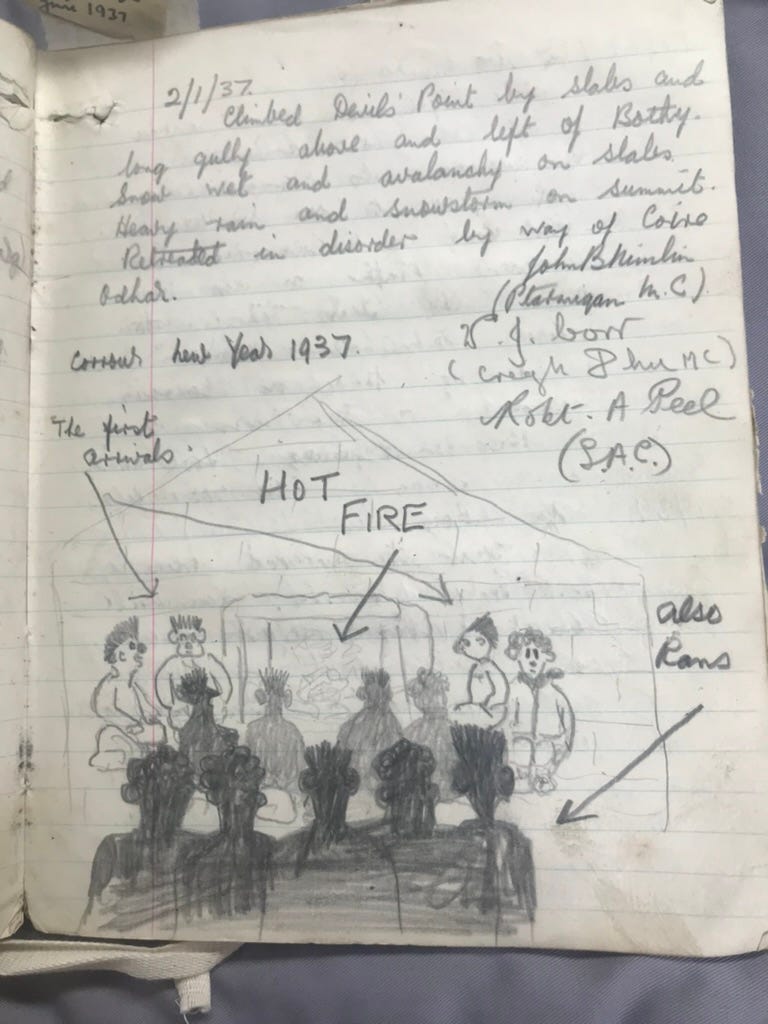
So gather round. I am calling all first-footers (and those who come after) to join me.
No one quite knows where the word ‘bothy’ first came from, but it’s probably a corruption of vernacular words for hut, the Irish bothán or Scottish Gaelic bothag or bothan.